Customer service is a layer cake
Good customer service needs six layers of work and someone who understands how they fit together.
I reckon running a good customer service operation now means understanding six layers of work. Being good at one leaves plenty of room to be crap at the whole thing.
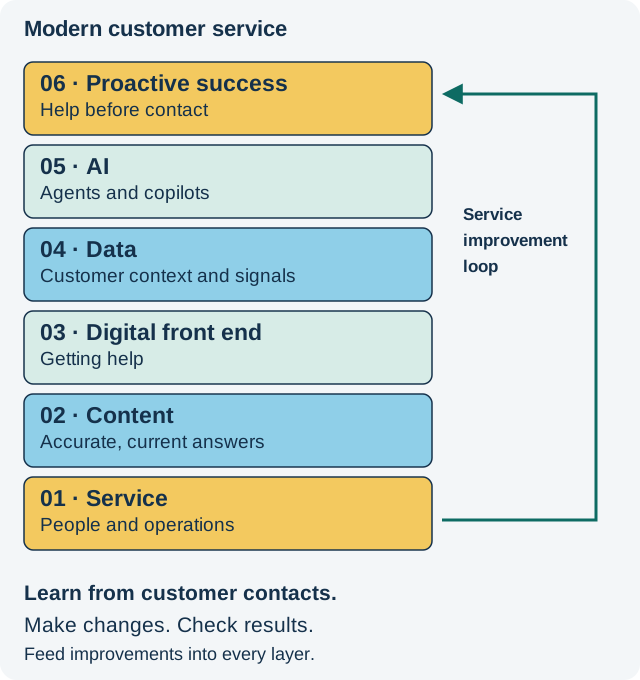
At the bottom are the people doing the service. They need to know their job, have permission to fix things and be available when customers need them. Someone has to take responsibility for whether the problem actually got sorted.
Closing the ticket doesn't settle that.
Then there's content. The answers need to exist, be right and stay current. Customers, staff and AI all need something reliable to work from.
If the answer lives in someone's head, everyone else gets to guess or interrupt them.
The digital front end is how customers get help. Search, chat, messaging, the help centre, whatever sits inside the product. Can they find the way in?
Can they reach a person when they need one? Making contact difficult is a fairly cheap way to reduce contacts, if that's all you're measuring.
Data gives the service some memory. Who is this customer? What have they already tried?
Why are people contacting us, and are they coming back with the same problem? Without that, every conversation starts with a small interrogation.
AI sits across that work. It can answer questions, take actions and help staff get through theirs. It also needs correct information, access to the right tools and somewhere sensible to send the work it can't finish.
Buying an agent leaves you with plenty to do.
Then there's proactive success. Spot the problem early enough and you might help before the customer has to ask. A useful warning can save someone an afternoon.
An automated “just checking in” message can give them another thing to delete. Knowing the difference depends on the layers underneath.
That's my layer cake.
You don't need to be the best person at every layer. You do need enough knowledge to recognise weak work and understand what it does to the rest.
A poor AI answer might start with an old article. A long queue might start with a broken screen. Repeated contacts might mean the customer never got the permission needed to finish the job.
Those problems cross team boundaries. The customer still needs someone to fix them.
The cake also needs maintenance. I'm beginning to think cake was a bad metaphor.
Read the conversations. Find what failed.
Change the content, the interface, the agent or the product. Then check whether the next customer has an easier time.
You can improve several layers at once. Waiting for perfect foundations is another way to never get started.
But someone has to understand how the whole thing works. Who does that in your operation?